Senior engineer attrition: see it coming while it can still be changed
The resignation letter is only the last event in a long chain of visible signals. This page has the six signals and the worksheet that prices one exit, free to copy. It ends with how Aurora Coach catches the chain early and turns it into changes, shown on a worked example.
Attrition is a lagging indicator of team conditions
Nobody is behaving badly when a team starts losing seniors. Delivery holds, people stay polite, the annual survey comes back fine. The conditions that made staying worth it stopped being maintained, and no instrument most companies run can see that.
The research agrees: SHRM puts senior roles at the top of the replacement-cost range, and Visier found coworkers 9.1 percent more likely to quit after a teammate leaves. The AI era sharpened it: days spent with agents instead of teammates, growth stalling into skill atrophy while output climbs, and a departing senior taking the only full mental model of what the agents built.
Attrition does not arrive. It accumulates, in conditions the team can see and nobody owns.
The six early-warning signals, free
Read them against each senior on your team. One signal is a mood; three or more, sustained for a month, is a trajectory.
- Stopped speaking up in retros and check-ins The person who used to argue about how the team works stops arguing. Caring about the process ends before caring about the job does. Whether problems get said at all is psychological safety.
- Stopped proposing improvements Suggestions are investments in a future here. When someone stops making them, they have often stopped picturing that future.
- Working increasingly alone Pairing stops, reviews shrink to rubber stamps, agents replace teammates as the first person asked. The full isolation drift is developer loneliness.
- Growth has stalled Nothing new learned in months, no task that stretched them. Senior engineers rarely leave over money alone; they leave when staying stops making them better.
- Only critical-path work The discretionary contributions go first: mentoring, docs, tooling for others. A senior doing exactly their tickets and nothing else is already halfway out.
- Knowledge stopped flowing outward They used to teach and write things down; now knowledge accumulates with them and stays. Watch this one, because it also prices the exit.
The cost-of-one-exit worksheet
Pick one senior you would hate to lose and work the five lines with real figures. The sum is what that one resignation costs, in a currency your leadership already budgets in.
- Replacement cost Take the annual salary. Multiply by 0.5 for a mid-level role, 1.0 for a senior, up to 2.0 for a lead with scarce domain knowledge. That covers recruiting, hiring, and lost productivity in one number, and the range is conservative per Gallup.
- Ramp time Estimate the months before a replacement is fully productive in your codebase; six to nine is typical for a senior hire. Charge half the new salary for each of those months. That is roughly what ramping costs in undelivered work.
- Comprehension walking out List the systems only this person fully understands. In an AI-heavy codebase, include everything where they supervised the agents. Per system, charge 8 to 20 hours of re-learning and incident time at your loaded hourly rate, more for anything customer-critical. What you are pricing is comprehension debt.
- Team drag Count the hours per week the people who stayed would absorb: extra review load, on-call cover, mentoring the replacement. Multiply by the months from resignation to full ramp, at the same loaded rate.
- The contagion term Add the four numbers, then multiply by 1.09 for the measured rise in teammates quitting after a departure. If one more senior actually goes, everything above runs twice.
Lines 1 through 4 added up, times the contagion factor: that is the cost of losing this one person. The conditions that prevent it cost a fraction of it.
What does it cost to lose a senior engineer?
Gallup estimates replacement cost at one-half to two times annual salary, rising with seniority, and describes that as a conservative range. That is before the months a successor needs to reach full productivity. The larger costs are less visible: comprehension debt on every system only they understood, extra load on the people who stayed, and the way one senior departure re-prices everyone else’s decision to stay.
What are the early warning signs an engineer is about to leave?
They disengage from the future before they leave the present: speaking up less in retros, no longer proposing improvements, working increasingly alone, stalled learning, dropping discretionary work like mentoring and docs, and knowledge that stops flowing outward. Each is observable in team behavior months before a resignation letter.
Can you improve retention without counteroffers?
Counteroffers act at the resignation, which is the most expensive and least effective moment. The conditions that make senior engineers stay are upstream and team-shaped: growth that continues, work with real ownership, connection to the people around them, and problems that get fixed when raised. Those are improvable conditions, and improving them is cheaper than replacing anyone.
From signals to changes: a worked example
Simulated team · Real product output Reading the chain early only counts if something happens next. Below is that on one team: Nordvik Health, a fictional remote-first health-tech scale-up. Six engineers across three countries, delivery solid, two senior resignations last quarter that the team lead did not believe the exit interviews about. We scripted the inputs and ran them through Aurora Coach in production. Everything below is the product's real output.
1Sense and analyze
Every team member answers structured questions in their own words, and can take any thread to the coach in a check-in. The answers roll up into a scored picture of the team's conditions.
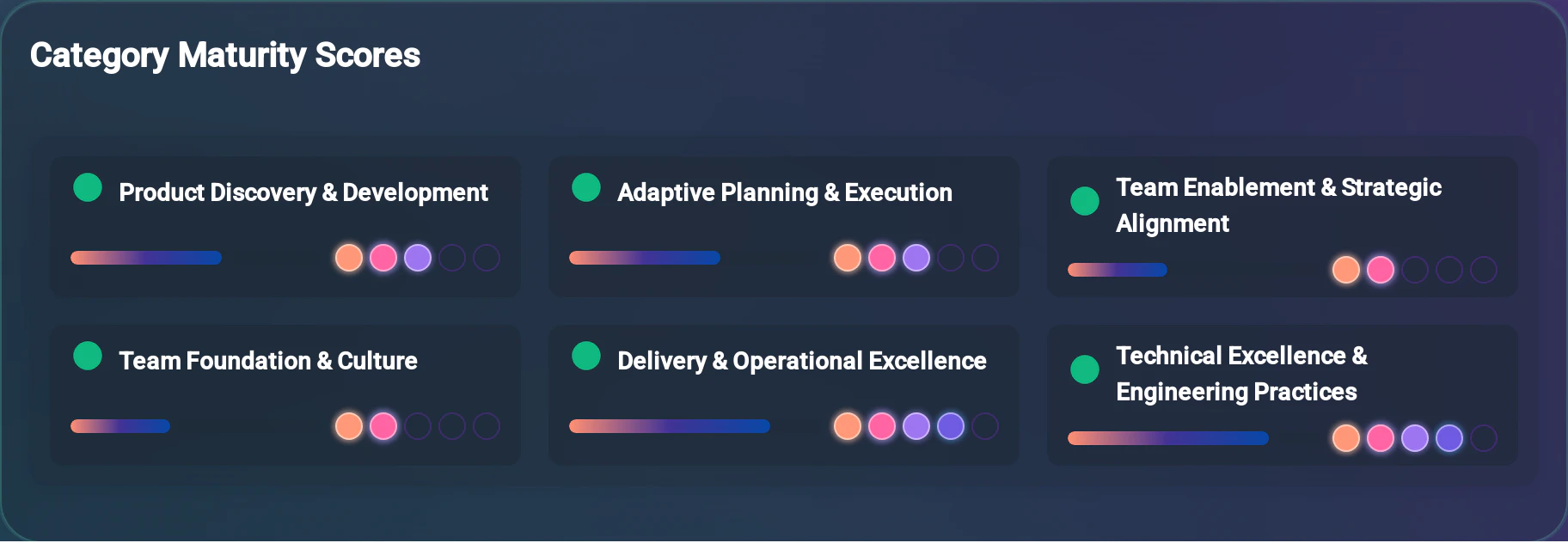
The conditions, scored
Count the filled dots: Foundation & Culture and Enablement sit at two of five while the delivery domains stay healthy. Delivery holding while the conditions erode is the exact pattern this page is about, and it is invisible on a sprint board. This is the six signals above, running as a dashboard.
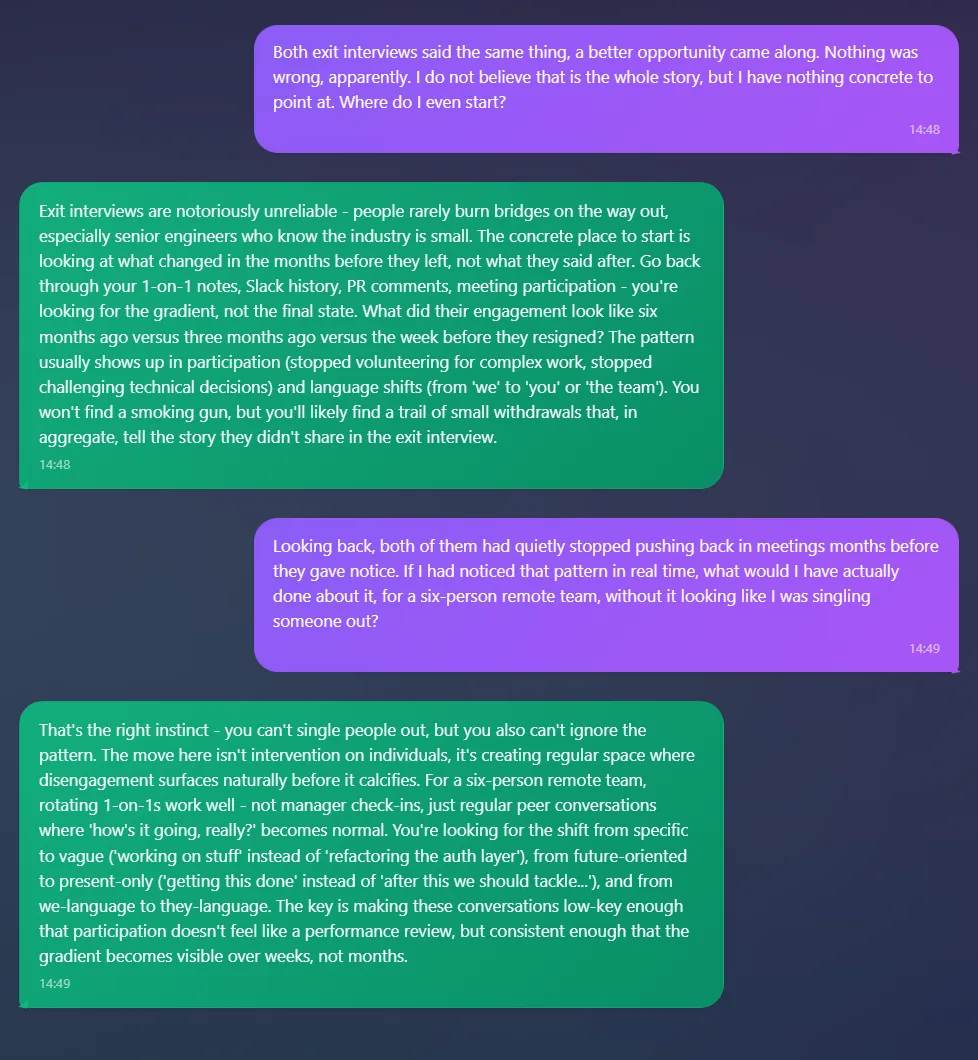
The exit interview that said nothing
The team lead brought her real question to a check-in. Her second message is the finding: both engineers had quietly stopped pushing back in meetings months before they gave notice. The coach points her at the gradient, not the final state: “a trail of small withdrawals that, in aggregate, tell the story they didn't share in the exit interview.” Signal one on the list above, caught in a five-minute conversation.
2Recommend, refine, commit
The low scores come with recommendations, and the recommendations become concrete suggestions the team votes on and commits to. The AI informs the decision, it does not make it.
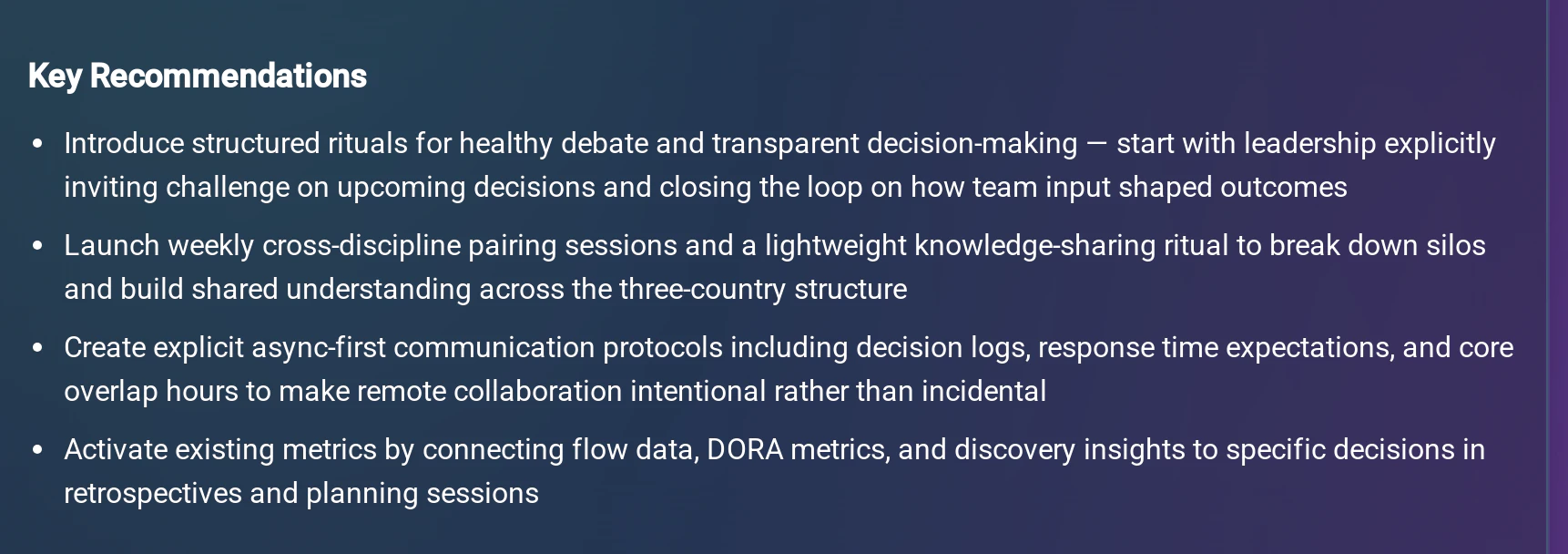
What to do about the two low scores
Four recommendations, generated from the same sessions. The second one, weekly cross-discipline pairing, answers two of the six signals directly: working alone, and knowledge that stopped flowing. It becomes a concrete suggestion the team votes on, below.
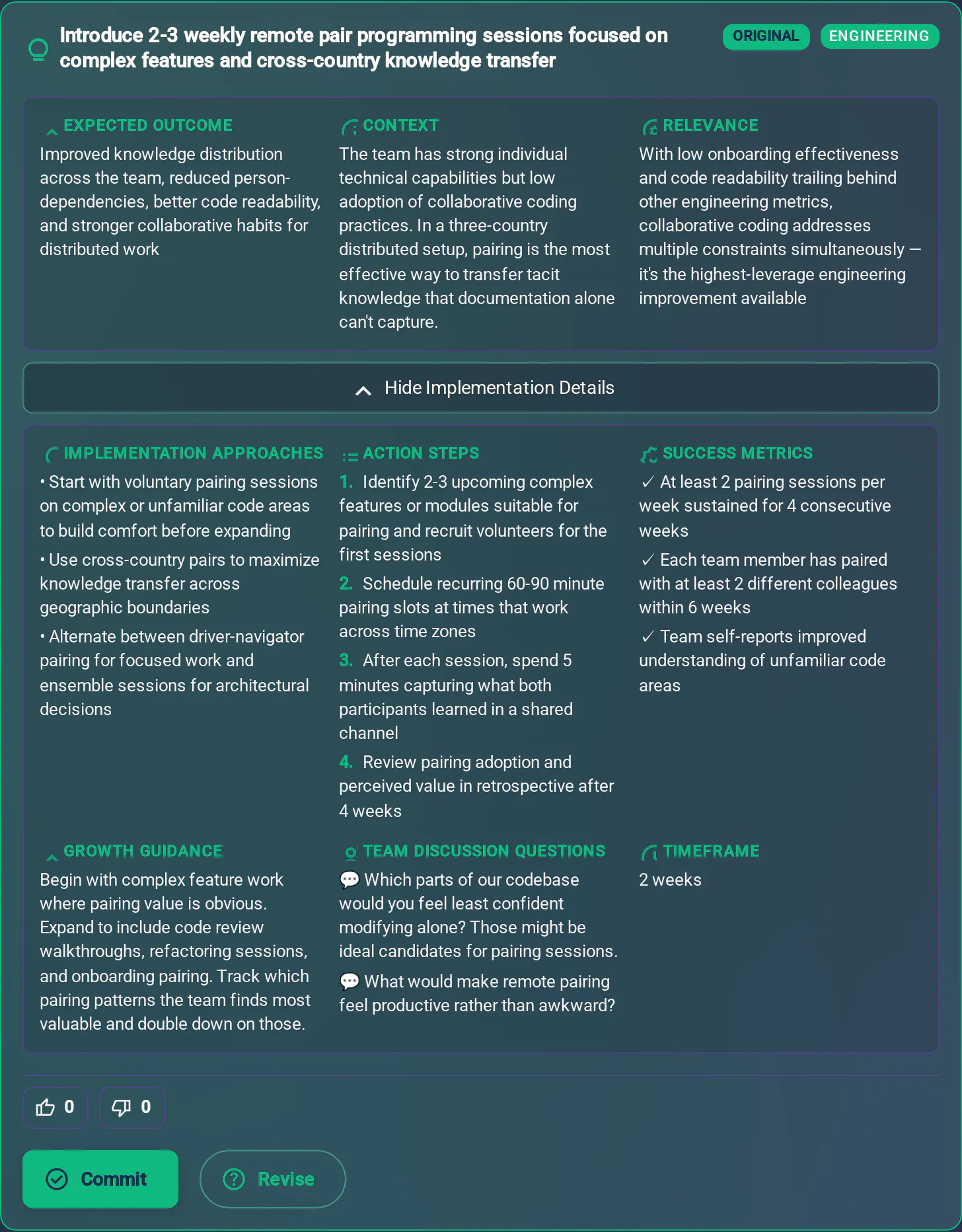
From recommendation to commitment
The pairing suggestion in full: action steps, success metrics, discussion questions, a timeframe. Read the Context field: it argues from this team's own situation, not from a template. That is what the product adds over this page. The signals list above is general knowledge; this is what it becomes for one specific team.
3Execute and re-evaluate
The team does the work in its own context. The next analysis shows whether the signals moved: people speaking up again, knowledge flowing outward. Nordvik has run one period. The trend view starts when the second one lands.
This is one use case. How the full product works is on the product overview.
Not ready to change anything today? You already have the signals list and cost worksheet above, copy buttons and all. If you want one improvement loop like these in your inbox each month, leave your email.
What this page cannot tell you is which of it applies to your team, this quarter. Aurora Coach works that out from your team's own words, recommends next steps with the reasoning, and the next period shows whether it held.
Both are free. The ROI mapper needs no signup and takes about two minutes. What team members write stays private to them: see AI governance.