AI skill atrophy: shipping fast, learning nothing
A team can hit record output for a year while its members lose the skills that output depends on. This page has the six-point learning agreement and the four pulse questions, free to copy. The last section shows the drift getting caught on a real run: a junior engineer's private worry becoming her team's commitment.
The research found the problem and the fix in the same data
Anthropic's own researchers ran a randomized controlled trial with 52 junior engineers learning a new library and published it in January 2026 as How AI assistance impacts the formation of coding skills. The AI-assisted group scored 17 percent lower on comprehension and debugging than those who coded by hand, with the largest gap was in debugging.
The same data holds the fix. The strongest learners in the study were not the abstainers; they were the engineers who used AI to ask conceptual follow-up questions and deepen their understanding.
Mode of use decides everything, and mode of use is a team norm, not an individual virtue.
The team learning agreement, free
Six commitments a team adopts together. Adapt the numbers; keep the shape: delegation is allowed, unexamined delegation is not.
- Struggle first on debugging A set time, say 30 minutes, alone with the error before handing it to an agent. Write down what you think is wrong before you delegate. That guess is the thing that gets better with practice.
- Ask why, not just fix When AI fixes something, the follow-up question is part of the job: why did this work, what was actually wrong? Two minutes, on whichever fix you understood least.
- Explain before merge The author can walk a teammate through any line of the change, agent-written or not. The norm is simple: what you cannot explain, you do not merge. The backlog it stops building up is comprehension debt.
- Teach-back rotation Each period, one person takes fifteen minutes to present something they learned well enough to teach: a concept, a subsystem, a failure. Teaching is the strongest test that the learning happened.
- Juniors own verification, seniors pair Verifying agent output is real work that builds real understanding of the codebase. Give it to juniors with a senior pairing, and the review bottleneck becomes the apprenticeship.
- Deliberate AI-free reps One small task per period done without assistance, chosen by the engineer. This is what keeps the calibration that agent supervision runs on: you cannot supervise an agent in a skill you no longer have.
The learning-pulse questions
Four questions for check-ins or one-on-ones. Ask them every period; the direction the answers move matters more than any single answer.
- What did you last debug without AI, and how did it feel? Answers drifting toward "cannot remember" are the early signal, months before it shows up in an incident.
- Could you rebuild what you shipped this week from scratch? Not whether you would; whether you could. The honest no is data about where understanding thinned, and it only gets said where saying it is safe. That part is psychological safety.
- What did you learn this period that you could teach? A period with plenty of merges and nothing teachable in it is worth a conversation.
- Where did AI surprise you, right or wrong? Surprise means the engineer still has a model of their own to be surprised against. No surprises for weeks can mean mastery, or it can mean nobody is checking.
What is AI skill atrophy?
The gradual loss of engineering skills, most visibly debugging and code comprehension, in engineers who delegate that work to AI without a deliberate practice for keeping the skill alive.
How do you prevent skill atrophy without banning AI tools?
Banning tools loses the potential productivity gains and does not build the skill. The working alternative is team norms about the mode of use: struggle-first windows before delegating a bug, conceptual follow-up questions as standard practice, explain-before-merge, teach-backs, and a small number of deliberate AI-free reps. The same research that found the atrophy found that engineers who used AI to deepen understanding learned the most of anyone. For orgs with a training budget, these norms are where it earns its keep: skill development that runs inside delivery instead of competing with it.
Are junior developers still worth hiring in the AI era?
Yes, and teams that stop will feel it in down the line when there are no seniors coming up behind. The role changes: verification of agent output, done with senior pairing, is real work that builds real codebase understanding, and it is exactly the work AI-heavy teams have too much of. The junior pipeline and the review bottleneck are each other’s solution.
From a private worry to a team norm: a worked example
Simulated team · Real product output Skill atrophy is a private worry long before it is a visible problem. Below is one team working it: the seven-person platform team at Vantora Labs, a fictional Series B SaaS. Agentic coding tools funded for every engineer, merged pull request volume roughly tripled in eighteen months. Pairing stopped being scheduled about a year ago and nobody decided that. We scripted the inputs and ran them through Aurora Coach in production. Everything below is the product's real output.
1Sense and analyze
Every team member answers structured questions in their own words, and can take any thread further with the coach in a check-in. Four Vantora sessions rolled up into one team analysis. The check-in below is the junior's, and it is the one that found the words.
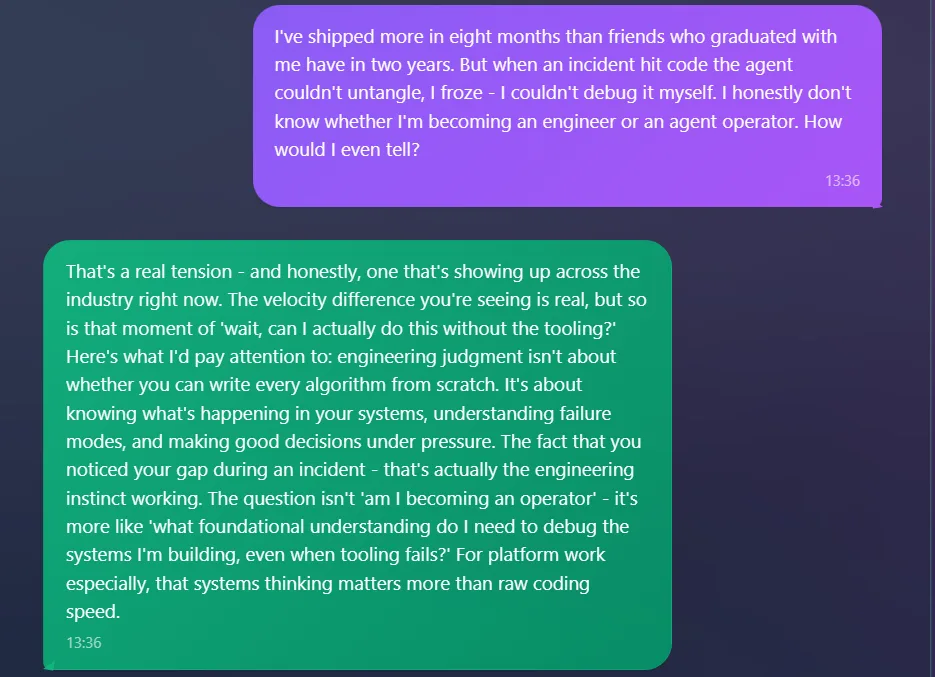
Eight months in, shipping fast, frozen in the incident
A junior engineer wrote this in her own check-in: “I've shipped more in eight months than friends who graduated with me have in two years. But when an incident hit code the agent couldn't untangle, I froze.” The coach answers the question she asked, which is a question about her: engineering judgment is knowing what happens in your systems, understanding failure modes, deciding well under pressure. Her next message is the one that changes the subject.
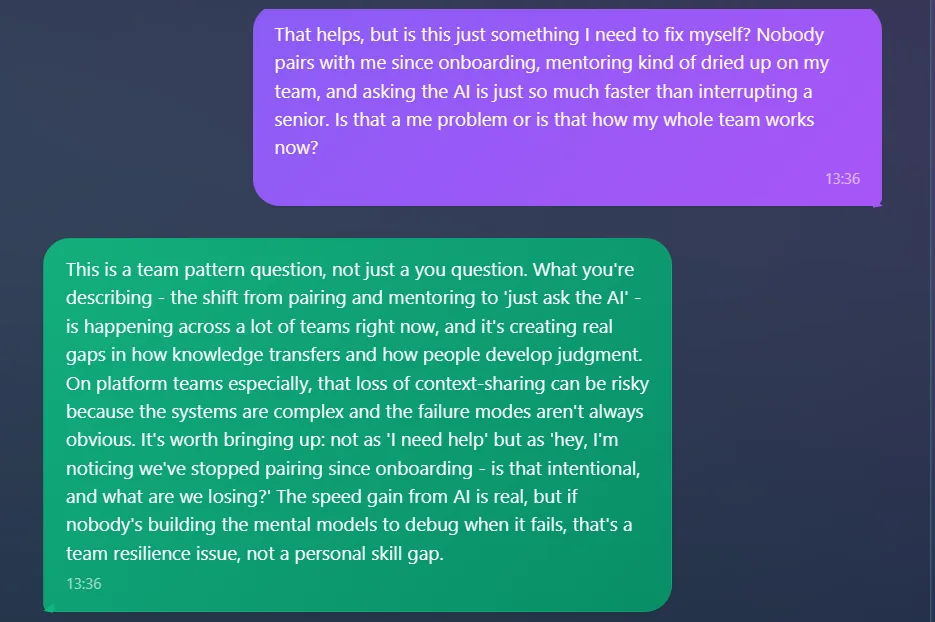
The same question, answered as a team problem
She pushed: is this a me problem, or is it how my whole team works now? The reply opens “This is a team pattern question, not just a you question” and lands on “if nobody's building the mental models to debug when it fails, that's a team resilience issue, not a personal skill gap.” It also gives her the sentence to open with: “hey, I'm noticing we've stopped pairing since onboarding”, then ask whether that was intentional and what it cost.
2Recommend, refine, commit
The analysis turns what she said, and what three teammates said from their own chairs, into suggestions the team votes on and commits to. The AI informs the decision, it does not make it.
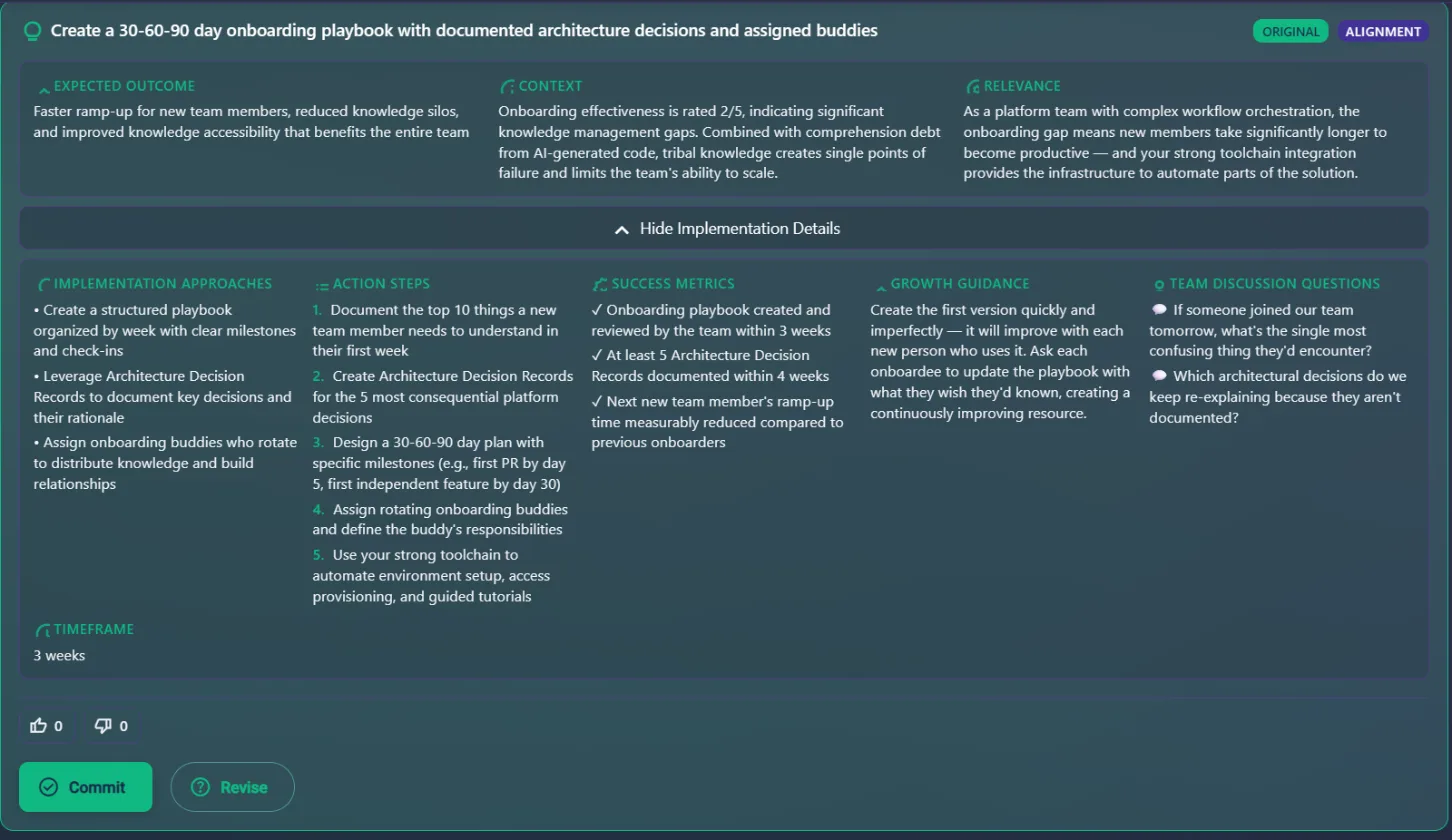
Rebuilding what pairing used to do
The improvement suggestion above is one of is the analysis answering that question structurally: a 30-60-90 day playbook with documented architecture decisions and assigned buddies, the machinery that used to build mental models rebuilt on purpose, with action steps, success metrics, and a three-week timeframe. The Context column argues from this team's own data: onboarding effectiveness scored 2 out of 5, tribal knowledge sitting in single points of failure, compounded by comprehension debt from AI-generated code. The vote counts read zero because nobody has voted yet, and Commit is what turns it into an improvement the team tracks.
3Execute and re-evaluate
The team runs the practice in its own context, not as a separate program. The next analysis shows whether it moved: pairing back on the calendar, people able to explain what they merged. Vantora has run one period. The trend view starts when the second one lands.
This is one use case. How the full product works is on the product overview.
Not ready to change anything today? You already have the learning agreement and pulse questions above, copy buttons and all. If you want one improvement loop like these in your inbox each month, leave your email.
What this page cannot tell you is which of it applies to your team, this quarter. Aurora Coach works that out from your team's own words, recommends next steps with the reasoning, and the next period shows whether it held.
Both are free. The ROI mapper needs no signup and takes about two minutes. What team members write stays private to them: see AI governance.