Psychological safety: from a one-off survey score to continuous improvement
Teams measure psychological safety with Amy Edmondson's seven-item survey, and then the score lands in a deck and nothing changes before the next measurement. This page has all seven items with the scale and the scoring, free to copy. The worked example at the bottom is a polite, quiet team whose score found its voice.
Why a single measurement fails
Almost every team that measures psychological safety measures it once. The number reports conditions the team built over months, one meeting and one mistake at a time. Google's re:Work research found how a team works together mattered more than who was on it, and named psychological safety the most important of the five dynamics it identified. Reporting it does not rebuild it.
The survey is itself an act of speaking up. If nothing visibly happens, the team just learned that speaking up changes nothing.
The 7 survey items and scoring, free
Seven statements, written by Aurora Coach after Amy Edmondson's 1999 study of work teams. The validated wording is in the paper, and The Fearless Organization Scan is the independent commercial instrument; neither is involved in this page. Rate each statement for your team, or with your own read of it, and the score appears below. Three are negatively worded; the flip is done for you. Nothing leaves your browser.
- 1 On this team, a mistake is held against the person who made it. reverse-scored
- 2 People on this team can raise problems and hard issues.
- 3 People on this team get rejected for being different. reverse-scored
- 4 Taking a risk on this team feels safe.
- 5 Asking teammates on this team for help is difficult. reverse-scored
- 6 People on this team trust that no one would deliberately undermine their efforts.
- 7 Each person’s distinct skills are recognized and put to use on this team.
The seven statements as a one-page handout for each team member to fill in anonymously, plus a tally sheet for whoever runs it. Leave your email and the PDF is sent to you right away, then one improvement loop like this one a month.
Measured once, the score is a snapshot. Measured every period, with one small change in between, it becomes the trend the research links to learning and performance.
That loop is what Aurora Coach runs. Team foundation and culture, psychological safety included, is one of its six improvement domains.
A few short questions about your team, then a quick read of what a loop like this is worth. No signup.
Between two measurements, change one thing
Measured once, the score is a verdict. Measured every period, it is a hypothesis you test: pick one change, run it for a period, see which item moved.
Five to start with. Each names the item it should move.
- The facilitator asks for everyone else’s read before giving their own. Item 2
- Reviews and postmortems describe the system, never the person. Item 1 Whether the fixes then get done is postmortem follow-through.
- Bad news gets a thank-you before it gets a fix discussion. Item 4
- Anyone who has gone quiet is asked about it by name within the week. Item 7 Where that silence goes next is engineer retention.
- Everyone names one thing they are stuck on at standup. Item 5 Where that stops, the drift is developer loneliness.
These are generic; a page cannot know your team. Aurora Coach writes the suggestion from what your team actually said, and the next period shows whether it held. Below is what that looked like for one team.
What do the 7 psychological safety survey items measure?
They are the seven survey items Amy Edmondson published in her 1999 study of work teams and later popularized in The Fearless Organization. The items probe mistakes, raising hard problems, being different, taking risks, asking for help, undermining, and whether individual skills are valued and used. Each is rated on a 7-point agree/disagree scale; items 1, 3, and 5 are negatively worded and reverse-scored. The exact wording is in Edmondson’s 1999 paper.
How do you measure psychological safety on a team?
Run the seven Edmondson items with no names attached: a survey with names measures willingness to look safe, not safety. Rate each on the 7-point scale and reverse-score items 1, 3, and 5. Read the results team-level and per item: a team can score well on five items and badly on two, and the two are the work. Then look at the spread on each item, not only the mean: an average of 5 where half answered 7 and half answered 3 has a subgroup for whom the team is not safe.
Can you improve psychological safety directly?
No. The score is a trailing indicator of how the team behaves: what happens after a mistake, who talks first, what asking for help costs. Talking about the score does not move it; committing to a concrete practice change and re-measuring does.
Is Edmondson’s psychological safety questionnaire free to use?
The seven items were published in Edmondson’s 1999 academic paper, and teams routinely run them internally with attribution. The Fearless Organization Scan is the commercial, supported version of the instrument. The seven statements, the scorer and the printable pack on this page are Aurora Coach’s own work after her research, not the validated instrument, and are not affiliated with or endorsed by Amy Edmondson, Harvard Business School or The Fearless Organization Scan.
From survey score to changes:
a worked example
Simulated team · Real product output Nordvik Health, a fictional remote-first health-tech scale-up. Six people, delivery solid, candor gone since a restructure merged two teams. We scripted the inputs and ran them through Aurora Coach in production. Everything below is the product's real output.
1Sense and analyze
Every team member answers structured questions in their own words, and can take any thread further in a check-in conversation. A form collects the rating; this collects the sentence behind it.
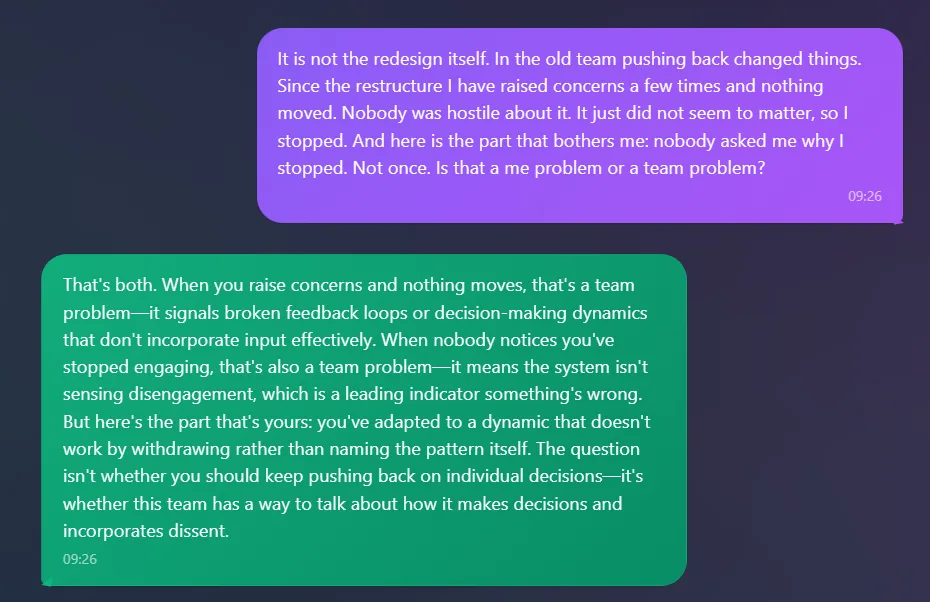
What one person was not saying
A senior engineer who used to fight for his positions: since the restructure he raised concerns a few times, nothing moved, so he stopped. “Nobody asked me why I stopped. Not once. Is that a me problem or a team problem?” The coach answers: that’s both. Concerns going nowhere signals broken feedback loops, and nobody noticing the silence means the team isn’t sensing disengagement.
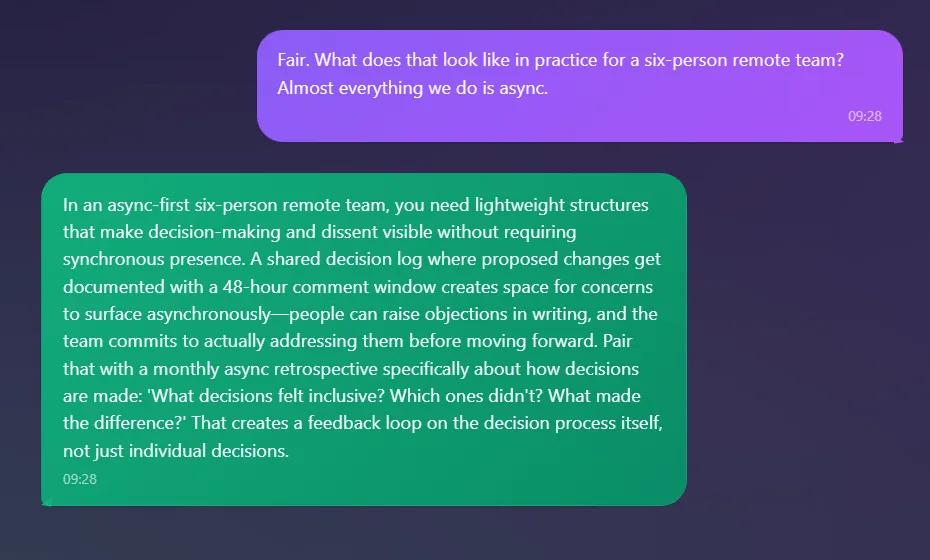
The follow-up he brought back
“What does that look like in practice for a six-person remote team? Almost everything we do is async.” The coach stays concrete: a shared decision log with a 48-hour comment window so objections surface in writing, and a monthly async retrospective about how decisions are made. A feedback loop on the decision process itself, not just individual decisions.
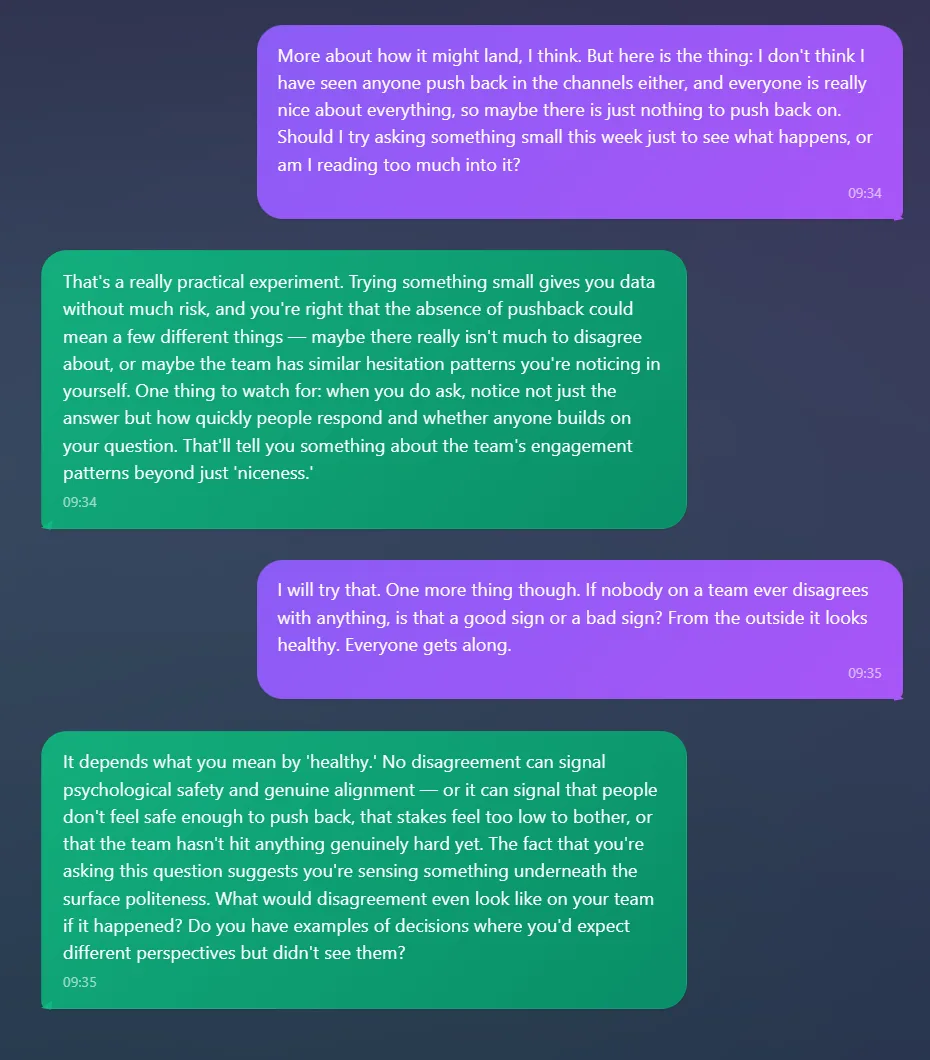
The newest member, reading the quiet
A newer engineer has not seen anyone push back either: everyone is really nice, so maybe there is just nothing to push back on. She asks it straight, and the coach declines the easy reading. No disagreement can mean genuine alignment, or it can mean people do not feel safe enough to push back. Verbatim: “The fact that you're asking this question suggests you're sensing something underneath the surface politeness.” That is an answer a 7-point scale has no room for.
2Recommend, refine, commit
The separate sessions roll up into a team analysis with category scores and recommendations. Each recommendation becomes a concrete suggestion the team votes on and commits to; the AI informs the decision, it does not make it.
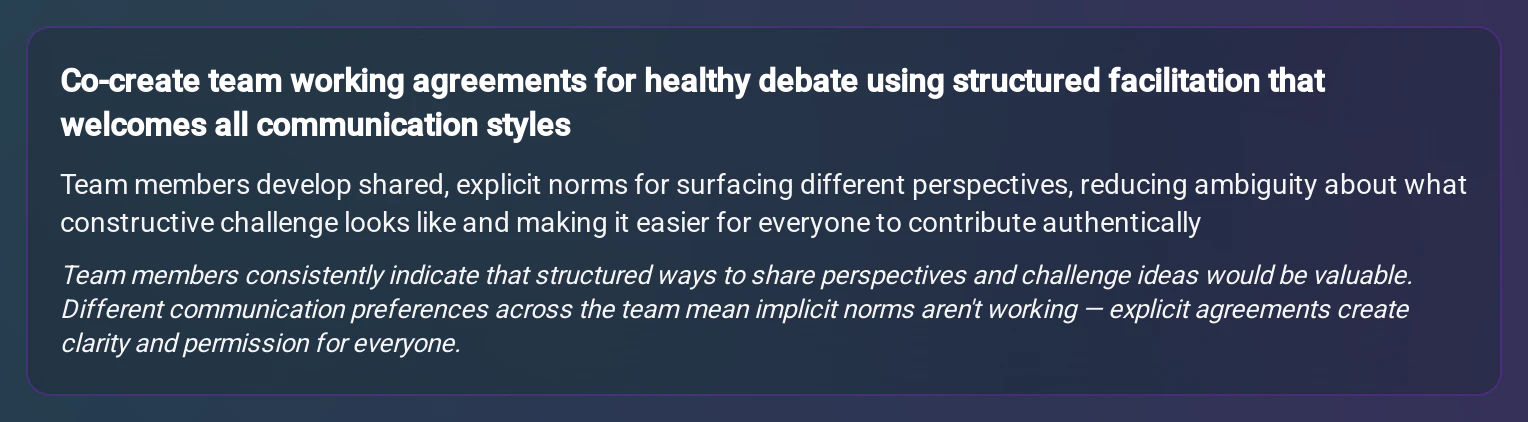
From what people said to what to change
One recommendation, generated from those sessions: agree explicitly, as a team, on what constructive challenge looks like. The italic line at the bottom of the card is the tell that no textbook wrote this: “Different communication preferences across the team mean implicit norms aren't working.” Edmondson's seven items can produce this team's low score; only this team's own answers could name the norm that has to change first.
3Execute and re-evaluate
The team does the work in its own context, and the next analysis shows whether the answers moved. Running the seven items again gives the second data point one measurement can never produce. Nordvik has run one period; the trend view starts when the second one lands.
This is one use case. How the full product works is on the product overview.
What this page cannot tell you is which of it applies to your team, this quarter. Aurora Coach works that out from your team's own words, recommends next steps with the reasoning, and the next period shows whether it held.
Both are free. The ROI mapper needs no signup and takes about two minutes. What team members write stays private to them: see AI governance.