Spotify squad health check: the free template, scored in your browser
The squad health check shows a team how it is doing across eleven dimensions. This page has the whole model, free: every dimension with its strong and weak example, traffic-light and trend buttons so you can score a squad right here, printable cards and a tally sheet for the workshop, and the six steps to run it. It ends with the common problem, a heat-map that changes nothing, and how Aurora Coach turns the check into changes, shown on a worked example.
The model, and where it stalls
Published by Henrik Kniberg and colleagues at Spotify in 2014, materials and all: eleven dimensions, traffic-light votes, and a trend arrow per dimension. The full mechanics are in the template and workshop steps below.
Run once or twice a year, the model stalls: the sprint takes over, nobody remembers what was decided, and two data points cannot show a trend.
The check sensed accurately; nothing was attached to the sensor.
The squad health check template, scored
Everything you need for the session, free. All eleven dimensions: Works well · Real problems, manageable · Serious. Vote a colour on each card, add a trend arrow if you have a previous check to compare with, and the picture appears below the cards. Nothing leaves your browser. Descriptions our own; the original deck is in Spotify's post above.
Delivering value
Green example: Stakeholders consistently get outcomes they value from us, and we stand behind what we ship.
Red example: We ship things we do not believe in, and stakeholders are not getting value.
Easy to release
Green example: A release is a routine event: automated, low-risk, over in minutes.
Red example: Every release is a slow, nervous, largely manual undertaking.
Fun
Green example: Working on this team gives us energy, and we genuinely enjoy each other.
Red example: The joy has drained out of the work.
Health of codebase
Green example: The code is clean and well-tested; we change any part of it with confidence.
Red example: Technical debt dominates the codebase, and every change is slow and scary.
Learning
Green example: We keep growing here; there is always something new being picked up.
Red example: Learning has stalled because the work leaves no room for it.
Mission
Green example: Our purpose is clear to everyone, and it motivates us.
Red example: Nobody could say what we are really here to achieve, and the stated mission moves no one.
Pawns or players
Green example: We shape our own direction: what we build and how we build it is largely our call.
Red example: Decisions about our work are made elsewhere; we just execute other people’s choices.
Speed
Green example: Work flows: we finish things quickly and rarely sit waiting.
Red example: Progress keeps stalling on interruptions, blockers, and dependencies.
Suitable process
Green example: Our way of working matches how this team actually operates.
Red example: Our process gets in the way more than it helps.
Support
Green example: When we ask for help, it arrives quickly and it is good.
Red example: Requests for help go nowhere, so we stay stuck.
Teamwork
Green example: We operate as one unit, pulling in the same direction.
Red example: We work side by side rather than together, with little idea of what the others are doing.
Voted once, the colours are a snapshot. Voted every period, with one change in between, the arrows become the trend the model was designed to show.
Aurora Coach runs that loop with the team. Every member answers in their own words, the eleven dimensions become six domain scores with the reasons behind them, and the team commits to one change before the next period re-evaluates it.
The Starter plan covers one team with every feature and a 14-day free trial: enough for one full loop. Managers and admins are free.
How to run the workshop
- Book one hour per squad Whole squad present, run by a facilitator the results do not reflect on.
- Walk one dimension at a time Read the green and red examples aloud. They are deliberately extreme; real teams land in between.
- Vote simultaneously Everyone shows green, yellow, or red at once, so nobody anchors on the loudest voice.
- Discuss, then agree Agree a consensus color plus a trend arrow (improving, stable, or declining) and capture a one-line note.
- Timebox 3–5 minutes per dimension Eleven dimensions fit in an hour only if deep dives get parked as improvement candidates.
- Discussion over averaging Do not average into a score; the conversation is the data. The output belongs to the squad, not a management scorecard, or voting turns political.
Spotify's 2023 follow-up, Getting more from your team health checks, adds a decade of facilitation experience: tailor the questions to the team, favor a deep conversation on one topic over covering all eleven, and treat the debrief afterwards as part of the check. The same conclusion this page draws: the workshop is the start, not the deliverable.
What is the Spotify squad health check?
A 2014 team self-assessment model from Henrik Kniberg and colleagues at Spotify. A squad votes traffic lights (green, yellow, red) on eleven dimensions, agreeing a consensus color and trend arrow per dimension in discussion rather than by averaging.
How often should we run a squad health check?
Quarterly workshops are common; once or twice a year kills the model, because two data points show no trend. Set a baseline in a workshop, then let free-text check-ins carry the signal between workshops.
What is the difference between a squad health check and a retrospective?
A retrospective asks what happened last period. A health check scans fixed dimensions that rarely surface in a retro: codebase health, mission, autonomy. The check finds the conversation worth having; the improvement loop acts on it.
Is there a free squad health check template?
Yes, on this page: all eleven dimensions of the Spotify model with a strong and a weak example description each, traffic-light and trend buttons on every card so you can score a squad in the browser, a print button for the cards and a tally sheet, the six workshop steps, and a copy button that puts the whole template on your clipboard. The descriptions are written in our own words; Spotify’s original deck is linked from the model section.
From check to changes: a worked example
Simulated team · Real product output A health check should end in changes. The team below is Nordvik Health, a fictional remote-first scale-up: six people, solid delivery, team health eroding after a restructure. We scripted the inputs and ran them through Aurora Coach in production. Everything below is the product's real output.
1Sense and analyze
Every team member answers structured questions in their own words. Workshop colors and free-text check-ins feed the same picture.
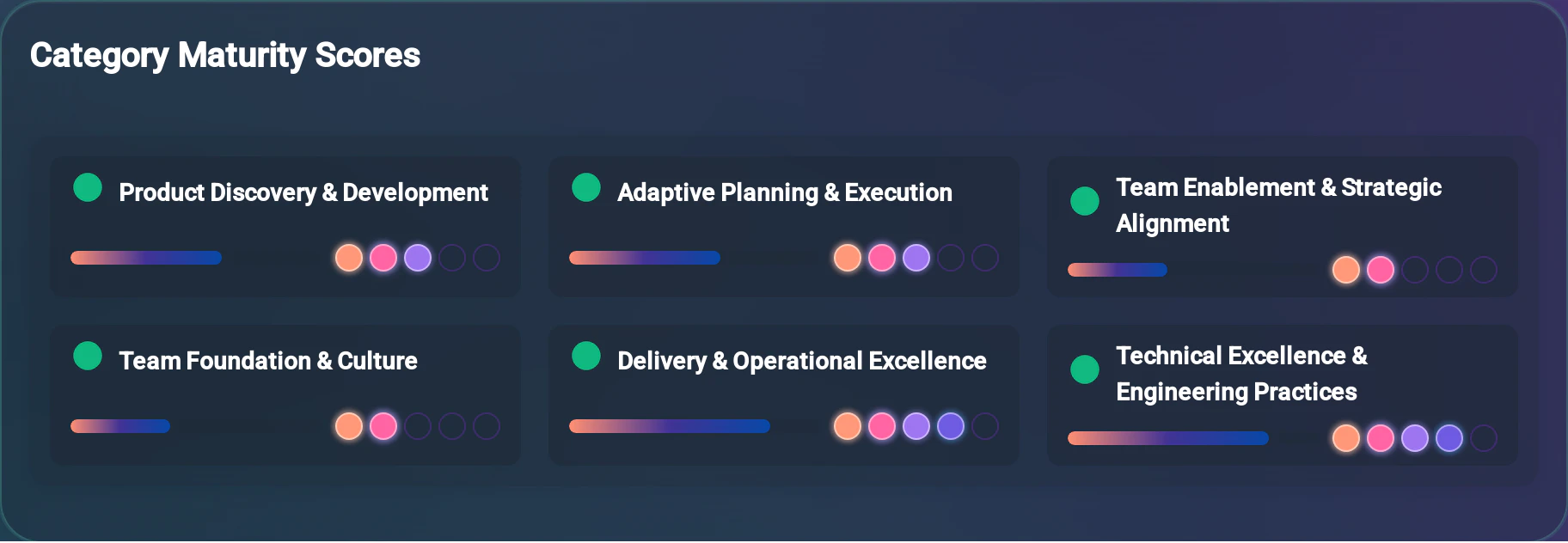
The heat-map, generated
Six domain scores from the individual sessions, no workshop hour needed. The check's eleven dimensions roll up here: safety, learning and autonomy into Foundation & Culture, codebase health into Technical Excellence, easy to release into Delivery. Count the filled dots: Foundation and Enablement sit at two of five while delivery stays healthy. This is the reading a red row exists to surface.
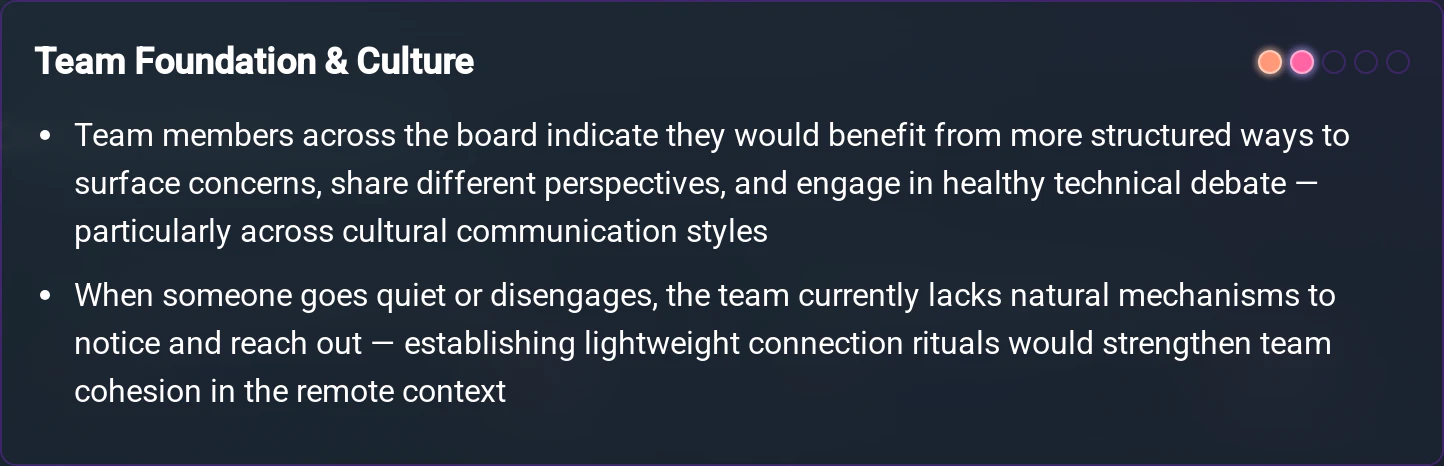
Why the score is low
Every low score states what drives it. Here: “when someone goes quiet or disengages, the team currently lacks natural mechanisms to notice and reach out.” Specific enough to act on.
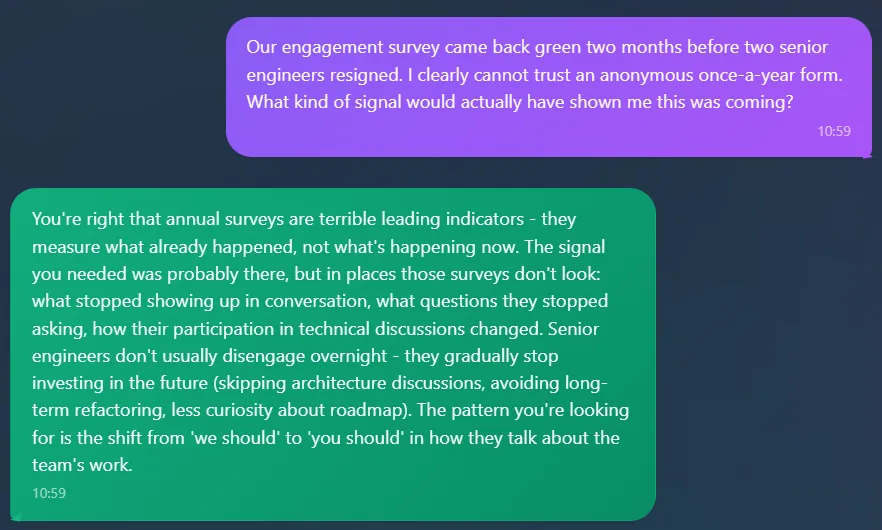
The question a survey can't ask
The team lead's real problem: the survey came back green two months before two senior engineers resigned. The coach's answer starts where the form fails: annual surveys measure what already happened. The signal lived in what stopped, questions no longer asked, architecture discussions skipped, and the shift from “we should” to “you should” in how the two engineers talked about the team's work.
2Recommend, refine, commit
The analysis becomes concrete suggestions the team votes on and commits to. The AI informs the decision, it does not make it.
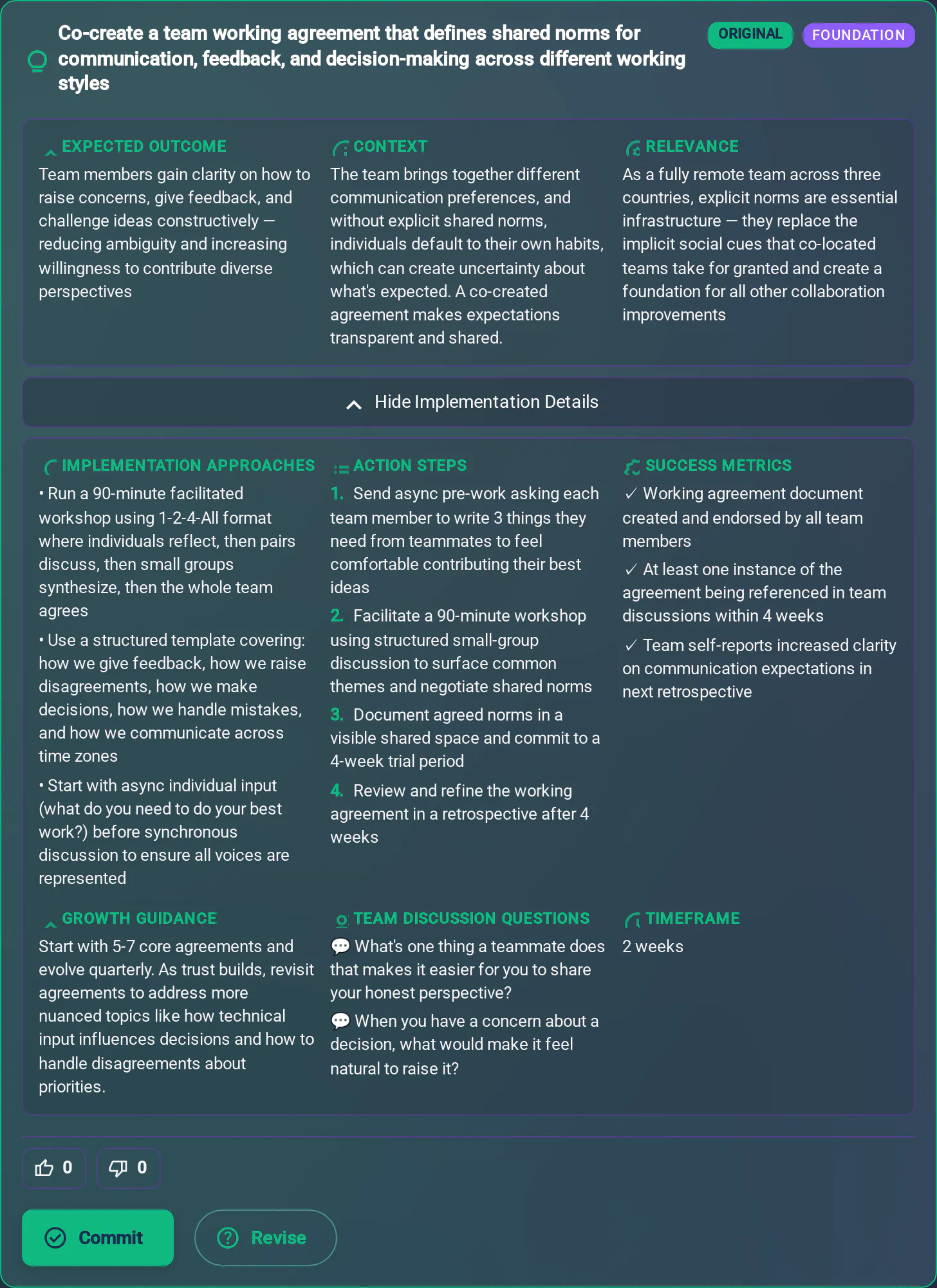
From low score to commitment
The Foundation read becomes a concrete move: a working agreement, with action steps, success metrics, discussion questions for the next retro, and a timeframe. Read the Context field: it argues from this team's own situation, not from a template. The eleven dimensions above are general knowledge; this is what they become for one specific team.
3Execute and re-evaluate
The team does the work in its own context. Next period's analysis shows what changed: progress against commitments, and the trend arrow the model always asked for, drawn from data. Nordvik has run one period. The trend view starts when the second one lands.
This is one use case. How the full product works is on the product overview.
Not ready to change anything today? You already have the full 11-dimension template above, copy buttons and all. If you want one improvement loop like these in your inbox each month, leave your email.
What this page cannot tell you is which of it applies to your team, this quarter. Aurora Coach works that out from your team's own words, recommends next steps with the reasoning, and the next period shows whether it held.
Both are free. The ROI mapper needs no signup and takes about two minutes. What team members write stays private to them: see AI governance.