Developer loneliness: the cost of working alone with agents
Engineers who used to think out loud with each other now think out loud with agents. The output went up; something human went missing. The five rituals and four check-in questions on this page are free to copy. The worked example at the bottom is one engineer's forty silent review comments becoming his team's pairing commitment.
Even the most AI-forward team in the world felt it
Fiona Fung manages the Claude Code and Cowork teams at Anthropic. On Lenny’s Podcast in June 2026, she named it directly: “after a while, we felt it could start being a lonely experience because we all started just working with our agents so much.” Fortune picked it up as a signal of a wider morale problem.
What Anthropic did next matters more than the admission. They did not slow down the AI; they added deliberate human structure, pairwise programming lunches and shared sessions where engineers show each other how they work. Connection went from a byproduct of the workflow, which agents removed, to a practice the team runs on purpose. That is the move, and any team can make it.
If the team that builds the agents gets lonely using them, so will yours.
The five connection rituals, free
Pick two, run them for a month, keep what the team actually shows up to. Imposed rituals die; chosen ones stick.
- Pairwise programming lunches Two engineers, side by side, not necessarily on the same thing. Presence is the point, the agenda is optional.
- Agent show-and-tell Fifteen minutes a week where someone demos how they actually work with their agents: prompts, workflow, failures included. Replaces the knowledge osmosis that pairing used to provide.
- Verification pairing Review agent-written changes in pairs instead of solo. The review gets better and it is the most natural shared work left when generation happens alone.
- One human question in standup Alongside the status round: what surprised you, what are you stuck on, who helped you? Standups that only sync agents’ output stop being a team touchpoint.
- Protected team time, on the calendar A recurring block that survives sprint pressure: demo circle, retro, or just working in the same room or call. Connection that depends on leftover time gets none.
The check-in questions that catch isolation early
Four questions for check-ins or one-on-ones. Watch the trend, not the single answer:
- When did you last work through a problem with a teammate, not an agent? "Weeks ago" from someone who used to pair daily is drift worth naming before it reads as disengagement.
- Who on the team knows what you are working on right now? "Nobody, really" is isolation and a bus-factor problem in the same sentence.
- Does the work feel more yours or more alone lately? Autonomy and isolation feel identical from the outside. Only the person can tell you which one is happening.
- If you were blocked tomorrow, who would you ask first? When the honest answer becomes "the agent" for everything, the team has stopped being the support system.
Why does AI-assisted development feel lonely?
Because the collaboration moved. Work that used to require a teammate, debugging together, reviewing together, thinking out loud, now happens between one engineer and their agents. The productivity is real and so is the isolation.
Is developer loneliness a productivity problem or a wellbeing problem?
Both, and the second becomes the first. Isolated engineers stop surfacing problems early, knowledge stops flowing between people, and disengagement reads as low performance long after it started as disconnection. Teams that treat connection as a working practice, not a perk, keep both the people and the throughput.
What can a team actually do about it?
Rebuild connection into the workflow rather than around it: pairing lunches, agent show-and-tells, verification done in pairs, one human question in standup, and protected team time that survives sprint pressure. Then watch the check-in answers, not the attendance: rituals people show up to but stay silent in are not working.
From isolation to changes: a worked example
Simulated team · Real product output Nordvik Health, a fictional remote-first health-tech scale-up. Six engineers across three countries, delivery solid, the pairing culture gone since a restructure took two seniors with it. We scripted the inputs and ran them through Aurora Coach in production. Everything below is the product's real output.
1Sense and analyze
Every team member answers structured questions in their own words, and can take any thread further in a check-in. Coding agents multiply what one person does alone; this AI points at the people, and everything it recommends is run between humans.
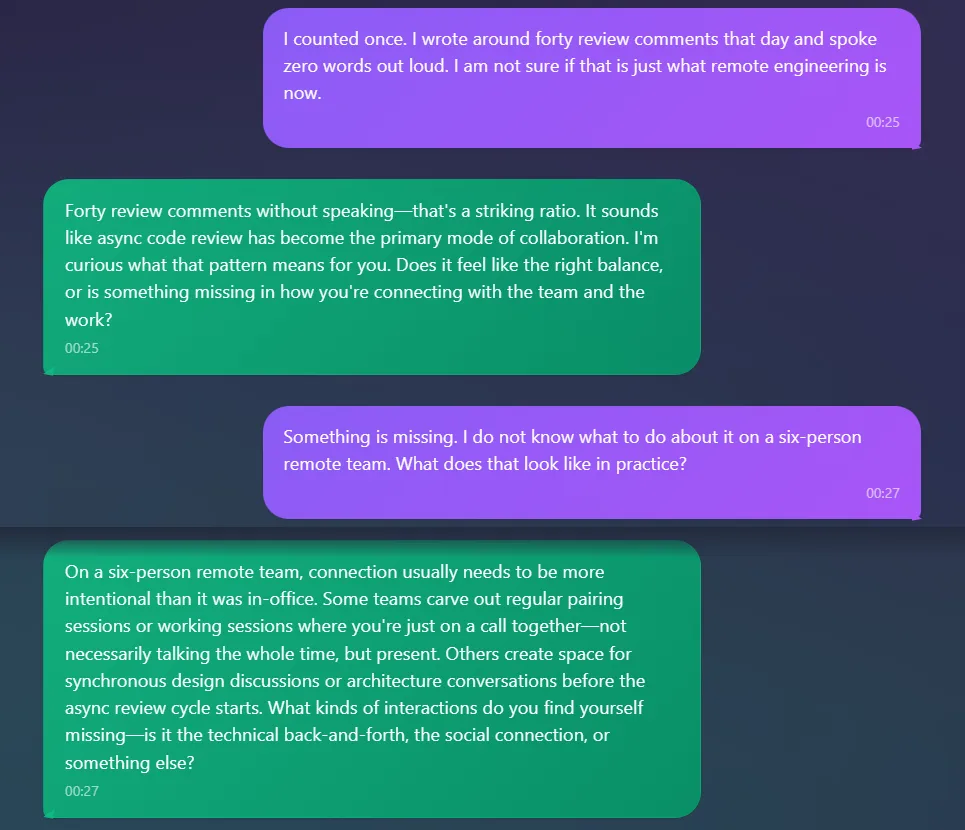
What an engineer actually says
The opening line is his own count: “around forty review comments that day and spoke zero words out loud.” No generic answer comes back. The coach names async review as the primary mode of collaboration, then asks which part is missing, the technical back-and-forth or the social. He says technical, and every suggestion that follows is built on that answer.
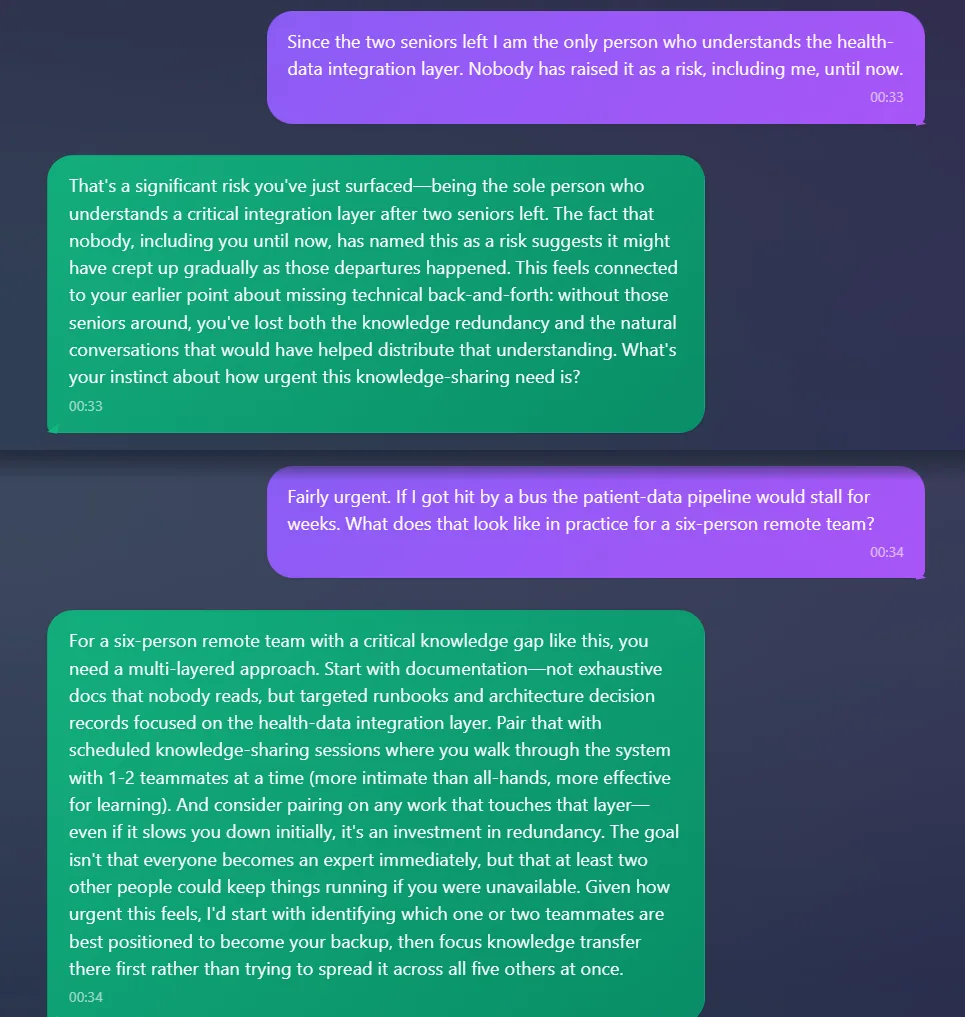
Two problems, one cause
Minutes later in the same check-in, on paper a different topic: he is the only person left who understands the health-data integration layer. The coach joins them up verbatim: “This feels connected to your earlier point about missing technical back-and-forth.” Isolation and bus factor, read as one structural gap.
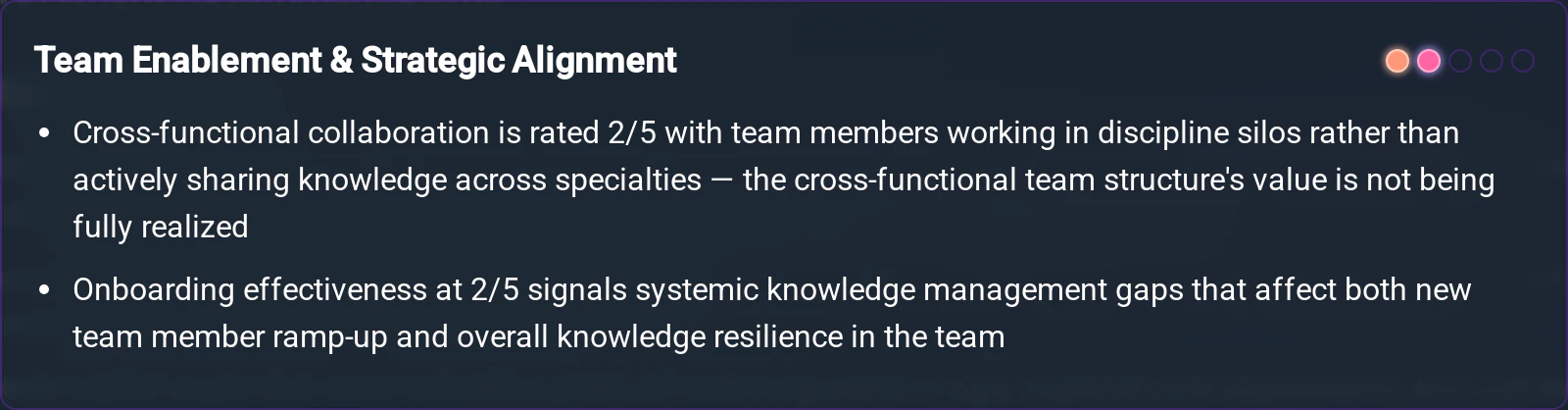
Where it lands at team level
Count the filled dots: Team Enablement sits at two of five. The card says what drives the score, not just the score: team members “working in discipline silos rather than actively sharing knowledge across specialties.” Nobody had to file a complaint for this to surface.
2Recommend, refine, commit
What he said becomes a suggestion his whole team votes on, while the conversation itself stays private. The AI informs the decision, it does not make it.
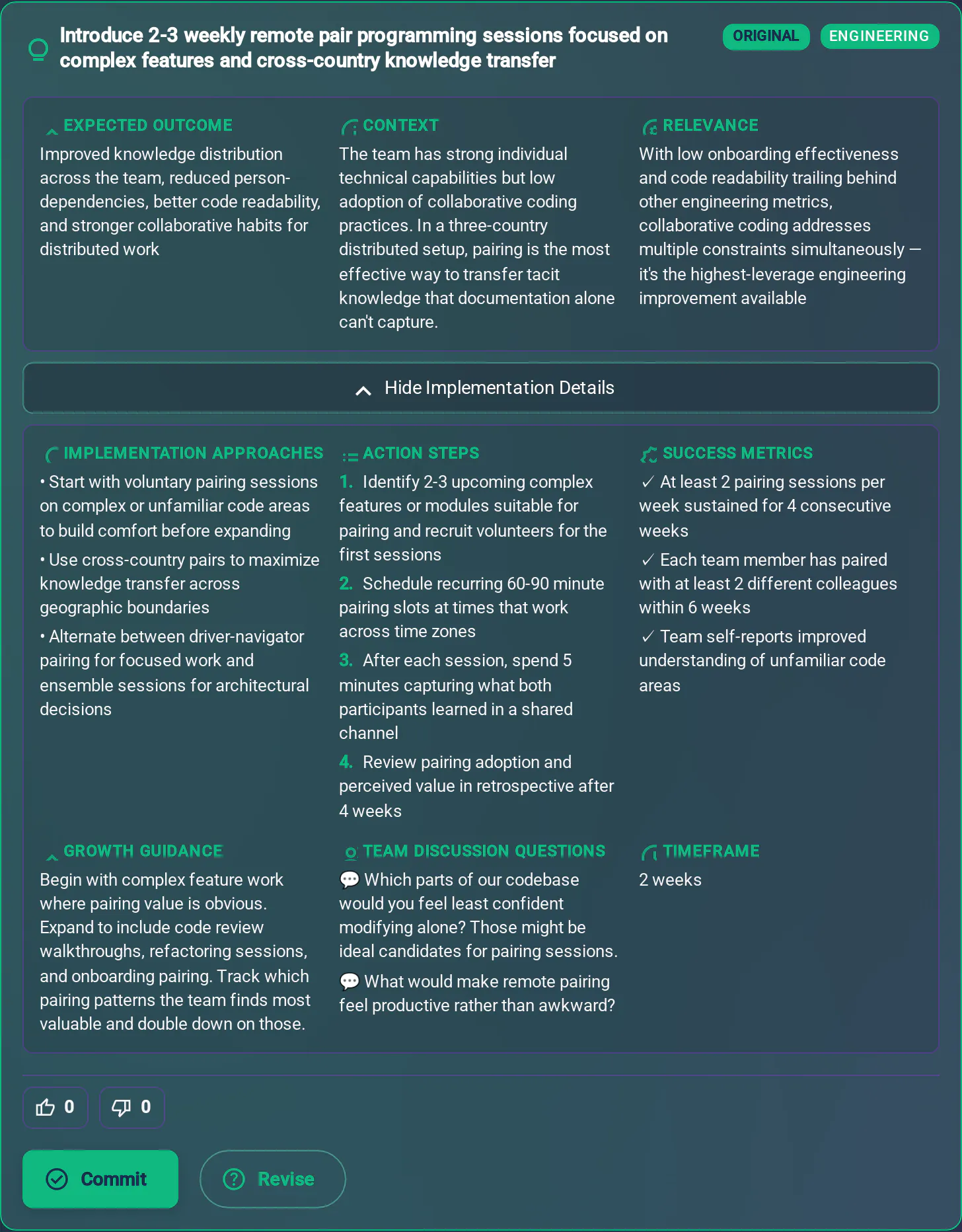
A ritual, not a platitude
What came back was pairing, with action steps, success metrics, discussion questions and a timeframe. The product's own reason, in its own words: “in a three-country distributed setup, pairing is the most effective way to transfer tacit knowledge that documentation alone can't capture.” The rituals list above could run anywhere; this one exists because a three-country team lost its pairing culture and one engineer said so out loud.
3Execute and re-evaluate
The team runs the ritual in its own weeks. The next period's analysis shows what moved: progress against what was committed, and whether the voices that had gone quiet came back. Nordvik has run one period. The trend view starts when the second one lands.
This is one use case. How the full product works is on the product overview.
Not ready to change anything today? You already have the rituals and check-in questions above, copy buttons and all. If you want one improvement loop like these in your inbox each month, leave your email.
What this page cannot tell you is which of it applies to your team, this quarter. Aurora Coach works that out from your team's own words, recommends next steps with the reasoning, and the next period shows whether it held.
Both are free. The ROI mapper needs no signup and takes about two minutes. What team members write stays private to them: see AI governance.