The AI adoption gap: half the team is flying, half opted back out
The seats are bought and the invoice repeats every month. The harder question is how many people on the team actually work differently now, and that is rarely everyone. Two free tools on this page: a six-question pulse that shows where your team stands, and a working agreement that closes the gap without mandates. It ends with how Aurora Coach turns the split into changes, shown on a worked example.
Bought per seat, decided per team
Fiona Fung manages the Claude Code and Cowork teams at Anthropic. When she listed what remains unsolved on her own teams, scaling culture was on the list: the tools multiply individuals, and nothing in the box multiplies the team.
Inside an ordinary team that lands as a spread. One engineer restructured the work around agents; the next tried an assistant in March, did not like what came back, and went back to typing. The seats cost the same either way. A usage dashboard counts logins, which is not the same as the work changing, and it cannot tell healthy skepticism from being stuck.
The agents were the easy line item. The way of working decides the return.
The six-question adoption pulse, free
Ask the whole team, out loud in a retro or in writing, once a month or once a quarter. Six answers give you the picture a usage dashboard cannot: where agents are earning their keep, where people gave up, and what it would take to close the distance.
- Where did an agent save you real time this period? Concrete wins, named. A team that cannot answer this is not adopting; a team where only two people can is adopting unevenly.
- Where did you try one and abandon it? Abandonment points are the map of where trust broke. They are also the cheapest thing to fix, because someone else on the team usually got past the same point.
- What do you not trust an agent with, and why? Distrust is information, not resistance. Some of it is correct and belongs in the team’s working agreement; some of it is three months out of date.
- What is blocking more use: access, skill, or doubt? Three different blockers, three different fixes. Access is a budget email, skill is a show-and-tell, doubt is a conversation the team has not had yet.
- Whose workflow would you like to see up close? Adoption spreads by demonstration, not decree. The names that come up here are the people to put in front of the team next.
- Has the team’s bar for merged code moved? Up, down, or forked into two bars depending on who wrote it. If review has turned into a rubber stamp on code nobody fully read, the problem to work next is the verification gap.
The adoption working agreement
Five clauses to adopt as written or argue with in your next retro. They close the gap without a single mandate:
- One bar, regardless of authorship We hold every change to the same review bar, whether a human, an agent, or both wrote it. Review depth follows the risk of the change, not its origin. Anything the author cannot explain does not get merged.
- We demonstrate, we do not mandate We keep a fifteen-minute slot each week where one of us shows how they actually work: the prompts, the workflow, and what failed. The rota is voluntary, and nobody is required to adopt what they see.
- Equal access, equal budget Everyone on the team gets the same tools, models, and usage limits, requested once and renewed without having to justify it. Where a spend cap applies, it applies to the team, not to a person.
- No individual scoreboard We measure adoption at team level, through the pulse above and through delivery outcomes. We do not track or report per-person usage, and tool use does not appear in performance reviews.
- Doubt is recorded, not overruled Anyone can decline to use an agent for a piece of work and states why. We write the reason down and revisit those calls once a quarter, because a sound objection in March can be out of date by June.
What is the AI adoption gap?
The spread inside one team between engineers working at agent speed and engineers who tried the tools once and opted back out. It shows up as forked quality bars, uneven review burden, and resentment running both directions. Fiona Fung, who manages Anthropic’s Claude Code teams, names scaling culture among the problems AI has not solved; the adoption gap is that problem at team size.
Should we mandate AI tool usage?
Mandates produce compliance theater: tokens burned, nothing trusted, and skeptics who stop objecting without being convinced. What closes the gap is conditions, not orders: equal access and budget, workflows demonstrated in the open, one quality bar regardless of authorship, and skeptics treated as a source of risk information rather than resistance.
How do you close the adoption gap without surveilling engineers?
Measure the team, not the person. A per-engineer usage dashboard kills the honest answers that make the gap fixable, and usage numbers cannot distinguish healthy skepticism from being stuck anyway. A team-level pulse, asked well and safely each period, shows where adoption actually stands and whether it is moving, which is the only thing leadership needs to know.
From a split team to changes: a worked example
Simulated team · Real product output Here is one team closing the split: Vantora Labs, a fictional Series B scale-up, seven engineers on the platform team, merged PR volume roughly tripled, adoption split down the middle. We scripted the inputs and ran them through Aurora Coach in production. Everything below is the product's real output.
1Sense and analyze
Everyone answers the same structured questions in their own words, and anyone can take a thread further in a check-in conversation. Both halves of the split describe it, and both land in the same picture.
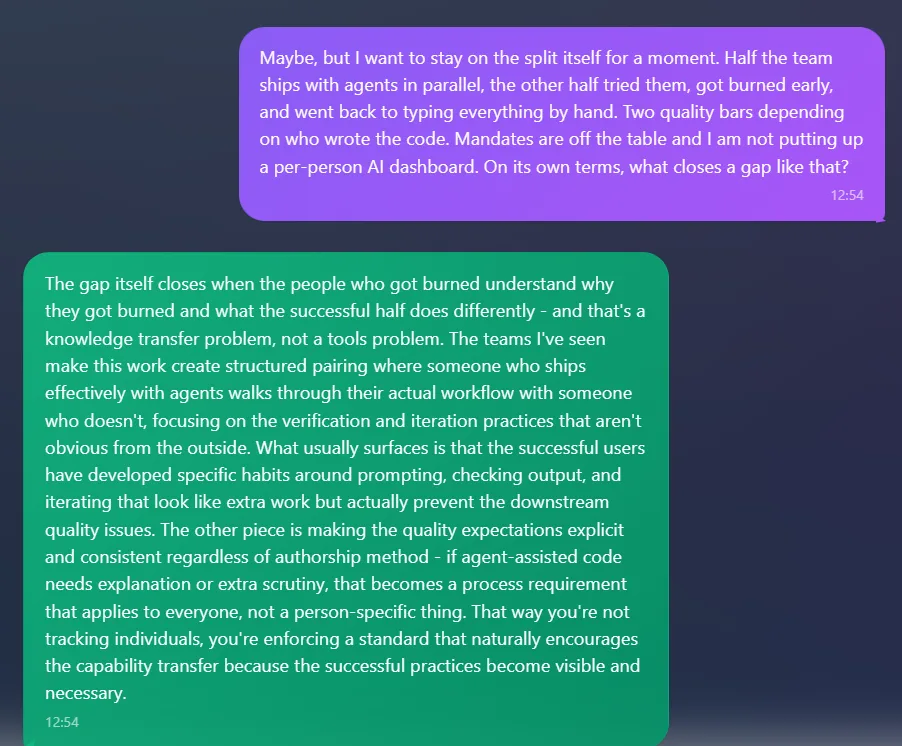
Two quality bars, named by the lead
The team lead rules out both default moves inside her own question: no mandate, no per-person dashboard. The coach does not smuggle them back in. It moves the problem off the people: the split is “a knowledge transfer problem, not a tools problem,” closed by pairing the half that ships with agents with the half that got burned, and by one explicit quality bar that applies to everyone regardless of who, or what, wrote the code.
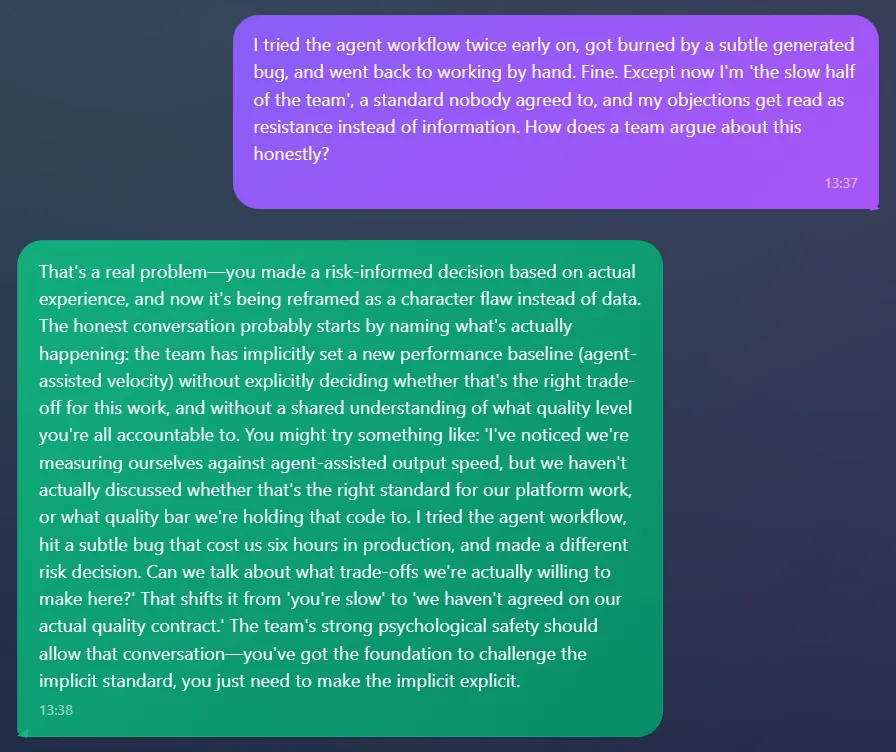
The same split from the other side
Tomas is the senior engineer on the other half. He tried the workflow twice, got burned by a generated bug, and is now “the slow half”. Question three of the free pulse above says distrust is information, not resistance. Working only from what he wrote, the coach lands in the same place: he made “a risk-informed decision based on actual experience” that is being “reframed as a character flaw instead of data.” Then it hands him the exact words to say out loud, and the argument stops being about his speed and becomes whether the team ever agreed on its actual quality contract.
2Recommend, refine, commit
The read turns into something the team can do on Monday: recommendations become concrete suggestions the team votes on and commits to. The AI informs the decision, it does not make it.
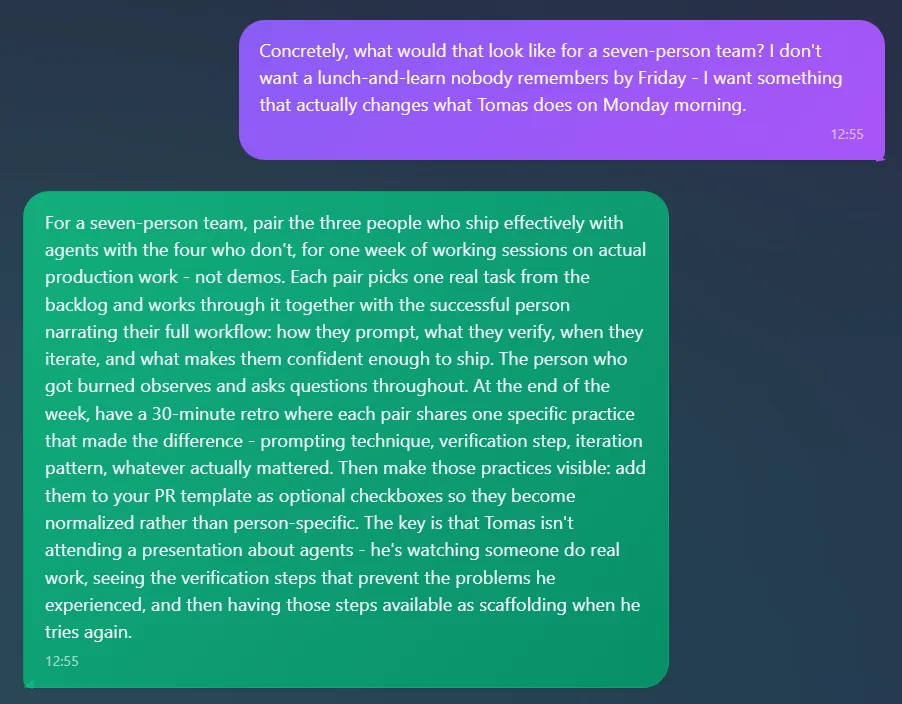
Pushed for concrete, it gets concrete
The lead refuses the lunch-and-learn and asks for something that changes what one named engineer does on Monday morning. What comes back is a mechanism, not a policy: pair the three who ship with agents with the four who don't for one week of working sessions on real backlog tasks, the successful person narrating how they prompt, what they verify, and when they iterate. A thirty-minute retro where each pair names the one practice that mattered, and those practices land in the PR template as optional checkboxes. “Tomas isn't attending a presentation about agents”: he watches someone do real work, and keeps the steps as scaffolding when he tries again. That is what the product adds over this page. “Show, don't mandate” in the working agreement above is general knowledge, true of any team; this is what it becomes for one team of seven with one named skeptic in it.
3Execute and re-evaluate
The team runs the change inside its normal week, and the next analysis shows whether the gap narrowed: fewer abandoned attempts, one bar holding. Then the next change. One step per period is what moves a way of working, and the steps compound. Vantora has run one period, so the trend view starts when the second one lands.
This is one use case. How the full product works is on the product overview.
Not ready to change anything today? You already have the adoption pulse and working agreement above, copy buttons and all. If you want one improvement loop like these in your inbox each month, leave your email.
What this page cannot tell you is which of it applies to your team, this quarter. Aurora Coach works that out from your team's own words, recommends next steps with the reasoning, and the next period shows whether it held.
Both are free. The ROI mapper needs no signup and takes about two minutes. What team members write stays private to them: see AI governance.